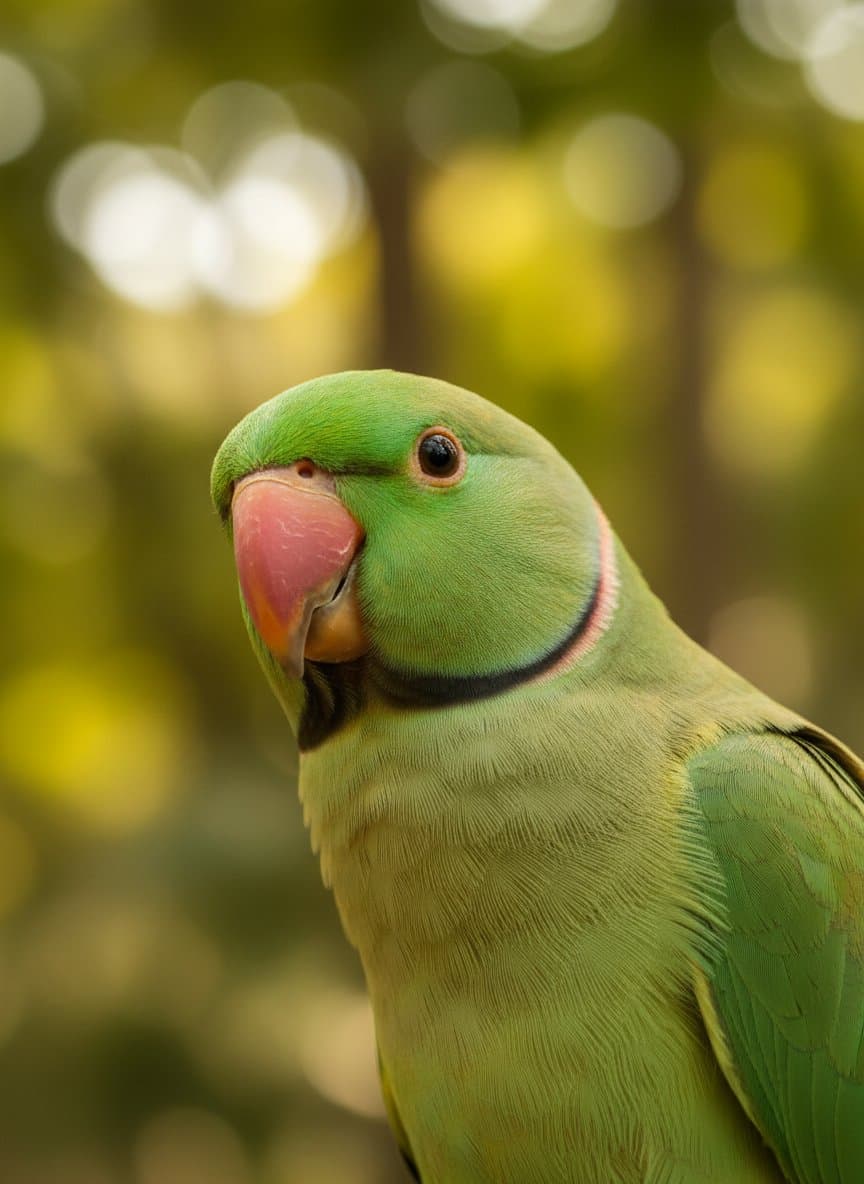
Indian Ringneck
(IRN / Ringneck Parakeet)
The bird that makes you work for the relationship. Worth every second of it.
The Real Story
Indian Ringnecks have a reputation that scares new owners off — and honestly, that reputation is earned. IRNs go through a 'bluffing phase' typically between 4 months and 1 year where a previously sweet bird suddenly bites, lunges, and wants nothing to do with you. New owners who don't know this is coming often give up. Experienced IRN owners know it passes — and what comes out the other side is one of the most intelligent, talkative, and visually spectacular parrots you can keep. The IRN community has a saying: survive the bluff and you have a bird for life.
'IRN' is the universal shorthand — nobody says 'Indian Ringneck Parakeet' in full. The 'ring' refers to the rose-and-black neck marking that appears in adult males around age 3 — females and juveniles don't have it, which surprises new owners who wonder why their 'ringneck' has no ring yet. Mutation breeding is a passionate subculture within the IRN world — lutino (yellow), blue, violet, turquoise, albino — each with devoted followings. An IRN's color mutation is often the first thing their owner mentions.
IRNs are among the best talkers in the medium-parrot category — clear, articulate, capable of large vocabularies. They are also notably independent compared to Amazons or cockatoos — they don't demand constant contact and can entertain themselves, making them well-suited to apartment life. What they need is daily interaction, mental stimulation, and an owner who respects that their affection is earned, not assumed.
What Keeps Indian Ringneck Owners Up At Night
Polyomavirus
CoveredA viral disease that particularly affects young birds and can cause sudden death in chicks or chronic illness in juveniles. Vaccination is available — ask your breeder. If your IRN came from a pet store with unknown vaccination history, discuss this with an avian vet early.
Psittacine Beak & Feather Disease (PBFD)
ConditionalProgressive feather loss and beak deformities. No cure. Highly contagious. Multi-bird households need strict quarantine for new additions.
Aspergillosis
CoveredFungal respiratory infection. IRNs in poor ventilation or damp environments are at higher risk. Voice changes and tail bobbing are early warning signs.
Chlamydiosis (Psittacosis)
CoveredBacterial, zoonotic. IRNs from large aviaries are higher risk due to multi-bird exposure. Treatable.
Proventricular Dilatation Disease (PDD)
ConditionalNo cure, management only. One of the most serious avian diagnoses. Specialist workup required.
Feather Destructive Behavior
ConditionalIntelligent birds need stimulation. Bored IRNs can develop FDB — and because IRNs are independent rather than emotionally needy, owners sometimes miss the under-enrichment signals until FDB appears.
One thing we wish every IRN owner knew"The bluffing phase is temporary. The bond you build after it is not. IRN owners who make it through year one with their patience intact end up with one of the most rewarding relationships in bird keeping. Protect that investment — in every sense of the word."
Coverage Options for Your Indian Ringneck
Nationwide Avian & Exotic
- Annual limit
- $7,500
- Deductible
- $100 / $250 / $500 / $1,000
- Reimbursement
- 50% / 70% / 80%
- Accident waiting period
- 14 days
- Illness waiting period
- 14 days
- Age restrictions
- None for avian/exotic
- Wellness add-on
- Not available for exotic pets
- Multi-pet discount
- 5%
- Any licensed avian vet accepted
- Yes
- Payment
- Check or ACH
- Est. monthly
- $18–$42 (species and age dependent)
"Nationwide is the carrier the parrot community trusts. 40+ years of avian claims. When it matters, they pay."
90% may be available for avian plans — we can confirm current options.
MetLife Pet Insurance
- Annual limit
- Up to $10,000
- Deductible
- $0 / $250 / $500 / $750 / $1,000 / $2,500
- Reimbursement
- 50% / 70% / 80% / 90%
- Accident waiting period
- 0 days (IMMEDIATE)
- Illness waiting period
- 14 days
- Payment
- Check, Zelle, PayPal, Apple Pay
- Est. monthly
- ~$28/month average
We verify current NY availability for your quote
Pet Assure
Pet Assure is a vet discount network, NOT accident-and-illness insurance. It will not cover an emergency. But for routine wellness visits, it saves real money.
- Basic
- $18/month → $350/year savings
- Essential
- $34/month → $650/year savings
- Premium
- $57/month → $1,100/year savings
Add-on to Nationwide or MetLife. Not a standalone option.
Ready to compare options for your Indian Ringneck? Get a personalized quote and we'll walk you through both carriers' current offerings.
Is Bird Insurance Worth It? Run The Numbers.
No opinion — just math.
Respiratory infection
- National avg claim: $283
- NYC estimate: $400–$800
- At 80% after $250: $280 back
- Break-even: 7 months of premiums
Foreign body ingestion
- National avg claim: $2,752
- NYC estimate: $1,500–$5,000+
- At 80% after $250: $2,360 back
- Break-even: 59 months of premiums
Major illness (aspergillosis)
- National avg claim: $2,150
- NYC estimate: $800–$3,500+
- At 80% after $250: $1,520 back
- Break-even: 38 months of premiums
Estimates based on Nationwide published claim data and NYC-area vet pricing research. For large parrots who may live 40+ years, continuous coverage with no age restrictions has value that no calculator fully captures.
Finding a Real Avian Vet in New York
There's a difference between a vet who "sees birds" and a certified avian specialist. Here's who actually knows what they're doing in the NYC area.
Center for Avian & Exotic Medicine
562 Columbus Ave, Manhattan (Upper West Side)
(212) 501-875020+ years in business. Part of Thrive Pet Healthcare. Physical exam ~$120. Accepts Scratchpay financing.
Long Island Bird & Exotics Veterinary Clinic
Long Island, NY (serves NYC metro)
VIP Membership $998.75/year — unlimited annual exams + 25% off all procedures. Multi-pet: $912.50 (2nd bird), $823.75 (3rd bird).
Schwarzman Animal Medical Center (AMC)
510 E 62nd St, Manhattan
Full specialty hospital. Treats exotic pets. Financial assistance program for income-eligible owners: amcny.org/financial-assistance. 24/7 exotic emergency capability — one of very few NYC hospitals with this.
Cornell University Veterinary Specialists (CUVS)
880 Canal St, Stamford, CT (~50 min from Manhattan)
(203) 595-2777Cornell-affiliated. First specialty consultation $195–$250. Verify avian/exotic availability at this location when calling.
Cornell University Hospital for Animals (CUHA)
930 Campus Rd, Ithaca, NY 14853
(607) 253-306039,000+ animals/year including birds. Open 24 hours. No referral required. First specialty consultation $195–$250. Payment plans available. ~3.5–4 hrs from NYC.
Vet information last verified: April 2026. Always call ahead to confirm new patient availability.
Three Layers of Protection
Insurance is one tool. Here's how to stack it with others, the way smart bird owners manage vet costs.
Insurance (Accident & Illness)
Nationwide or MetLife covers unexpected illness and accidents. This is your protection against the $2,000–$8,000 bills that can blindside any bird owner. Get this first.
Practice Membership (Routine Wellness)
Long Island Bird & Exotics VIP Membership ($998.75/year) covers unlimited routine exams and 25% off all procedures. Stack with insurance: insurance handles emergencies, membership handles everything routine.
Emergency Financing Backstop
Before an emergency happens, get pre-approved for Scratchpay (scratchpay.com). Free to check rates, doesn't affect credit score, $200–$10,000 available instantly when needed. Accepted at Center for Avian & Exotic Medicine, NYC.
- Schwarzman AMC: amcny.org/financial-assistance
- NY State Vet Medical Society: nysvms.org/help-with-vet-bills
- Mayor's Alliance for NYC Animals: animalalliancenyc.org