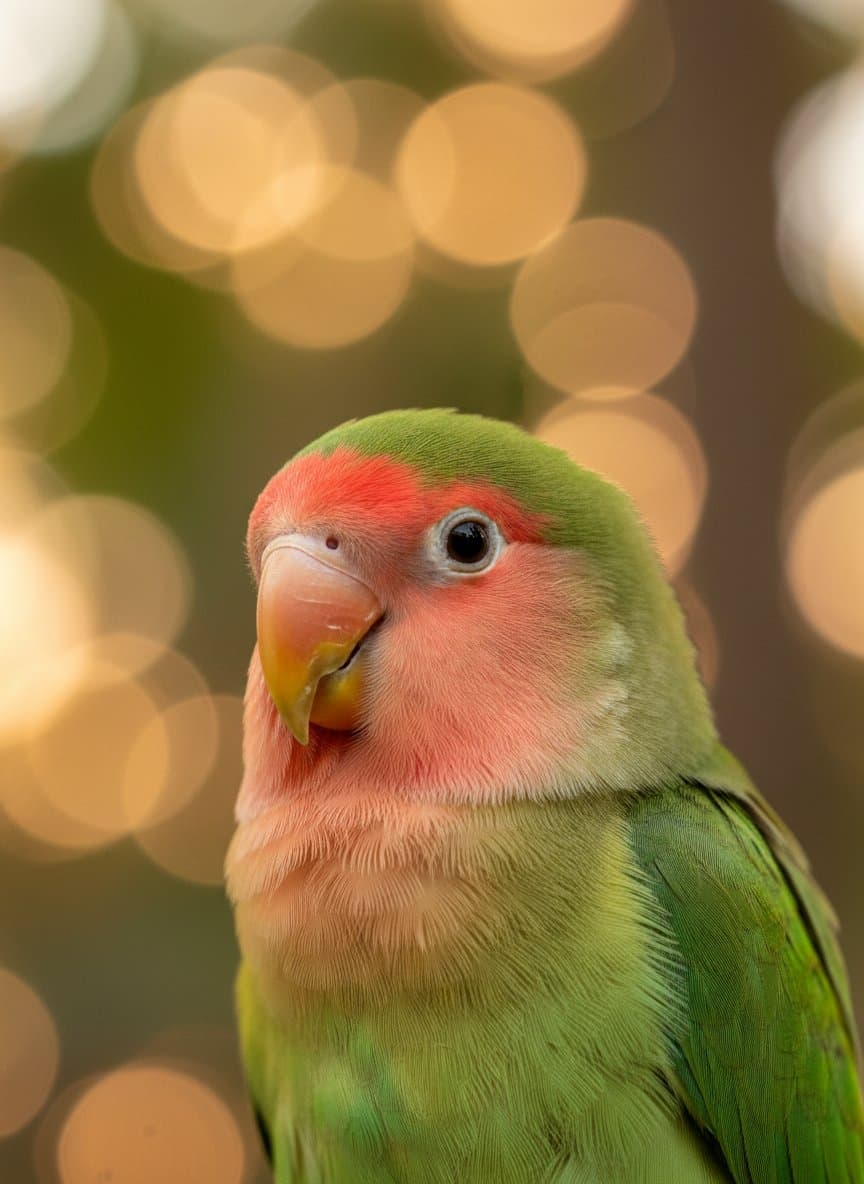
Lovebird
Tiny. Ferocious. Deeply misunderstood.
The Real Story
Lovebirds are named for their intense pair bonds — pairs groom each other obsessively, sleep pressed together, and grieve visibly when separated. This has created a myth that lovebirds must always be kept in pairs. The reality is more nuanced: a hand-raised lovebird bonded to a human is a complete companion on its own. A lovebird kept with another lovebird from the start will bond to that bird and become progressively less interested in human interaction. The community debates this endlessly.
Tiny. Ferocious. These words appear in every description of lovebirds for good reason. They are the smallest birds in this guide and among the most territorially aggressive per ounce. A lovebird that has decided it doesn't like something will attack it with complete commitment. This is also why their owners love them — there's nothing low-energy about a lovebird.
Peach-Faced Lovebirds are most common in the U.S., followed by Fischer's and Masked Lovebirds. The mutation breeding world for Peach-Faced in particular is elaborate — Dutch Blue, Lutino, Pied, American Cinnamon — and mutation-specific owners appreciate when you know what they're talking about.
What Keeps Lovebird Owners Up At Night
Egg Binding (females)
CoveredSingle female lovebirds are prolific egg layers. Egg binding is a genuine emergency that lovebird owners are more likely to face than owners of most other species.
Chlamydiosis
CoveredBacterial, zoonotic. Standard disease profile. Treatable.
Respiratory Infections
CoveredSmall body, sensitive respiratory system. Infections progress faster in lovebirds than in larger species — act quickly.
Feather Destructive Behavior
ConditionalIsolated lovebirds or birds with inadequate enrichment can develop FDB. More common in single birds without sufficient human interaction.
Heavy Metal Toxicity
CoveredCurious and mouthy. Lead and zinc ingestion risk is real in birds allowed to chew hardware, cage accessories, or household items.
Coverage Options for Your Lovebird
Nationwide Avian & Exotic
- Annual limit
- $7,500
- Deductible
- $100 / $250 / $500 / $1,000
- Reimbursement
- 50% / 70% / 80%
- Accident waiting period
- 14 days
- Illness waiting period
- 14 days
- Age restrictions
- None for avian/exotic
- Wellness add-on
- Not available for exotic pets
- Multi-pet discount
- 5%
- Any licensed avian vet accepted
- Yes
- Payment
- Check or ACH
- Est. monthly
- $18–$42 (species and age dependent)
"Nationwide is the carrier the parrot community trusts. 40+ years of avian claims. When it matters, they pay."
90% may be available for avian plans — we can confirm current options.
MetLife Pet Insurance
- Annual limit
- Up to $10,000
- Deductible
- $0 / $250 / $500 / $750 / $1,000 / $2,500
- Reimbursement
- 50% / 70% / 80% / 90%
- Accident waiting period
- 0 days (IMMEDIATE)
- Illness waiting period
- 14 days
- Payment
- Check, Zelle, PayPal, Apple Pay
- Est. monthly
- ~$28/month average
We verify current NY availability for your quote
Pet Assure
Pet Assure is a vet discount network, NOT accident-and-illness insurance. It will not cover an emergency. But for routine wellness visits, it saves real money.
- Basic
- $18/month → $350/year savings
- Essential
- $34/month → $650/year savings
- Premium
- $57/month → $1,100/year savings
Add-on to Nationwide or MetLife. Not a standalone option.
Ready to compare options for your Lovebird? Get a personalized quote and we'll walk you through both carriers' current offerings.
Is Bird Insurance Worth It? Run The Numbers.
No opinion — just math.
Respiratory infection
- National avg claim: $283
- NYC estimate: $400–$800
- At 80% after $250: $280 back
- Break-even: 7 months of premiums
Foreign body ingestion
- National avg claim: $2,752
- NYC estimate: $1,500–$5,000+
- At 80% after $250: $2,360 back
- Break-even: 59 months of premiums
Major illness (aspergillosis)
- National avg claim: $2,150
- NYC estimate: $800–$3,500+
- At 80% after $250: $1,520 back
- Break-even: 38 months of premiums
Estimates based on Nationwide published claim data and NYC-area vet pricing research. For large parrots who may live 40+ years, continuous coverage with no age restrictions has value that no calculator fully captures.
Finding a Real Avian Vet in New York
There's a difference between a vet who "sees birds" and a certified avian specialist. Here's who actually knows what they're doing in the NYC area.
Center for Avian & Exotic Medicine
562 Columbus Ave, Manhattan (Upper West Side)
(212) 501-875020+ years in business. Part of Thrive Pet Healthcare. Physical exam ~$120. Accepts Scratchpay financing.
Long Island Bird & Exotics Veterinary Clinic
Long Island, NY (serves NYC metro)
VIP Membership $998.75/year — unlimited annual exams + 25% off all procedures. Multi-pet: $912.50 (2nd bird), $823.75 (3rd bird).
Schwarzman Animal Medical Center (AMC)
510 E 62nd St, Manhattan
Full specialty hospital. Treats exotic pets. Financial assistance program for income-eligible owners: amcny.org/financial-assistance. 24/7 exotic emergency capability — one of very few NYC hospitals with this.
Cornell University Veterinary Specialists (CUVS)
880 Canal St, Stamford, CT (~50 min from Manhattan)
(203) 595-2777Cornell-affiliated. First specialty consultation $195–$250. Verify avian/exotic availability at this location when calling.
Cornell University Hospital for Animals (CUHA)
930 Campus Rd, Ithaca, NY 14853
(607) 253-306039,000+ animals/year including birds. Open 24 hours. No referral required. First specialty consultation $195–$250. Payment plans available. ~3.5–4 hrs from NYC.
Vet information last verified: April 2026. Always call ahead to confirm new patient availability.
Three Layers of Protection
Insurance is one tool. Here's how to stack it with others, the way smart bird owners manage vet costs.
Insurance (Accident & Illness)
Nationwide or MetLife covers unexpected illness and accidents. This is your protection against the $2,000–$8,000 bills that can blindside any bird owner. Get this first.
Practice Membership (Routine Wellness)
Long Island Bird & Exotics VIP Membership ($998.75/year) covers unlimited routine exams and 25% off all procedures. Stack with insurance: insurance handles emergencies, membership handles everything routine.
Emergency Financing Backstop
Before an emergency happens, get pre-approved for Scratchpay (scratchpay.com). Free to check rates, doesn't affect credit score, $200–$10,000 available instantly when needed. Accepted at Center for Avian & Exotic Medicine, NYC.
- Schwarzman AMC: amcny.org/financial-assistance
- NY State Vet Medical Society: nysvms.org/help-with-vet-bills
- Mayor's Alliance for NYC Animals: animalalliancenyc.org